
Why Gemfury?
Push, build, and install
RubyGems
npm packages
Python packages
Maven artifacts
PHP packages
Go Modules
Debian packages
RPM packages
NuGet packages
 seanyen
seanyen / tensorflow python
Repository URL to install this package:
|
Version:
1.14.0 ▾
|
# Copyright 2015 The TensorFlow Authors. All Rights Reserved.
#
# Licensed under the Apache License, Version 2.0 (the "License");
# you may not use this file except in compliance with the License.
# You may obtain a copy of the License at
#
# http://www.apache.org/licenses/LICENSE-2.0
#
# Unless required by applicable law or agreed to in writing, software
# distributed under the License is distributed on an "AS IS" BASIS,
# WITHOUT WARRANTIES OR CONDITIONS OF ANY KIND, either express or implied.
# See the License for the specific language governing permissions and
# limitations under the License.
# ==============================================================================
# pylint: disable=invalid-name
"""Test utils for tensorflow."""
from __future__ import absolute_import
from __future__ import division
from __future__ import print_function
import collections
from collections import OrderedDict
import contextlib
import functools
import gc
import itertools
import math
import os
import random
import re
import tempfile
import threading
import unittest
from absl.testing import parameterized
import numpy as np
import six
_portpicker_import_error = None
try:
import portpicker # pylint: disable=g-import-not-at-top
except ImportError as _error:
_portpicker_import_error = _error
portpicker = None
# pylint: disable=g-import-not-at-top
from google.protobuf import descriptor_pool
from google.protobuf import text_format
from tensorflow.core.framework import graph_pb2
from tensorflow.core.protobuf import config_pb2
from tensorflow.core.protobuf import rewriter_config_pb2
from tensorflow.python import pywrap_tensorflow
from tensorflow.python import tf2
from tensorflow.python.client import device_lib
from tensorflow.python.client import session
from tensorflow.python.eager import context
from tensorflow.python.eager import def_function
from tensorflow.python.eager import tape
from tensorflow.python.framework import device as pydev
from tensorflow.python.framework import dtypes
from tensorflow.python.framework import errors
from tensorflow.python.framework import errors_impl
from tensorflow.python.framework import importer
from tensorflow.python.framework import ops
from tensorflow.python.framework import random_seed
from tensorflow.python.framework import sparse_tensor
from tensorflow.python.framework import tensor_shape
from tensorflow.python.framework import versions
from tensorflow.python.ops import array_ops
from tensorflow.python.ops import control_flow_util
from tensorflow.python.ops.ragged import ragged_tensor
from tensorflow.python.ops.ragged import ragged_tensor_value
from tensorflow.python.ops import script_ops
from tensorflow.python.ops import variables
from tensorflow.python.platform import googletest
from tensorflow.python.platform import tf_logging as logging
from tensorflow.python.training import server_lib
from tensorflow.python.util import compat
from tensorflow.python.util import deprecation
from tensorflow.python.util import nest
from tensorflow.python.util import tf_decorator
from tensorflow.python.util import tf_inspect
from tensorflow.python.util.protobuf import compare
from tensorflow.python.util.tf_export import tf_export
# If the below import is made available through the BUILD rule, then this
# function is overridden and will instead return True and cause Tensorflow
# graphs to be compiled with XLA.
def is_xla_enabled():
return False
try:
from tensorflow.python.framework.is_xla_test_true import is_xla_enabled # pylint: disable=g-import-not-at-top
except:
pass
@tf_export("test.gpu_device_name")
def gpu_device_name():
"""Returns the name of a GPU device if available or the empty string."""
for x in device_lib.list_local_devices():
if x.device_type == "GPU" or x.device_type == "SYCL":
return compat.as_str(x.name)
return ""
def assert_ops_in_graph(expected_ops, graph):
"""Assert all expected operations are found.
Args:
expected_ops: `dict<string, string>` of op name to op type.
graph: Graph to check.
Returns:
`dict<string, node>` of node name to node.
Raises:
ValueError: If the expected ops are not present in the graph.
"""
actual_ops = {}
gd = graph.as_graph_def()
for node in gd.node:
if node.name in expected_ops:
if expected_ops[node.name] != node.op:
raise ValueError("Expected op for node %s is different. %s vs %s" %
(node.name, expected_ops[node.name], node.op))
actual_ops[node.name] = node
if set(expected_ops.keys()) != set(actual_ops.keys()):
raise ValueError("Not all expected ops are present. Expected %s, found %s" %
(expected_ops.keys(), actual_ops.keys()))
return actual_ops
@tf_export("test.assert_equal_graph_def", v1=[])
def assert_equal_graph_def_v2(expected, actual):
"""Asserts that two `GraphDef`s are (mostly) the same.
Compares two `GraphDef` protos for equality, ignoring versions and ordering of
nodes, attrs, and control inputs. Node names are used to match up nodes
between the graphs, so the naming of nodes must be consistent. This function
ignores randomized attribute values that may appear in V2 checkpoints.
Args:
expected: The `GraphDef` we expected.
actual: The `GraphDef` we have.
Raises:
AssertionError: If the `GraphDef`s do not match.
TypeError: If either argument is not a `GraphDef`.
"""
assert_equal_graph_def(actual, expected, checkpoint_v2=True)
@tf_export(v1=["test.assert_equal_graph_def"])
def assert_equal_graph_def_v1(actual, expected, checkpoint_v2=False):
"""Asserts that two `GraphDef`s are (mostly) the same.
Compares two `GraphDef` protos for equality, ignoring versions and ordering of
nodes, attrs, and control inputs. Node names are used to match up nodes
between the graphs, so the naming of nodes must be consistent.
Args:
actual: The `GraphDef` we have.
expected: The `GraphDef` we expected.
checkpoint_v2: boolean determining whether to ignore randomized attribute
values that appear in V2 checkpoints.
Raises:
AssertionError: If the `GraphDef`s do not match.
TypeError: If either argument is not a `GraphDef`.
"""
assert_equal_graph_def(actual, expected, checkpoint_v2)
def assert_equal_graph_def(actual, expected, checkpoint_v2=False):
if not isinstance(actual, graph_pb2.GraphDef):
raise TypeError("Expected tf.GraphDef for actual, got %s" %
type(actual).__name__)
if not isinstance(expected, graph_pb2.GraphDef):
raise TypeError("Expected tf.GraphDef for expected, got %s" %
type(expected).__name__)
if checkpoint_v2:
_strip_checkpoint_v2_randomized(actual)
_strip_checkpoint_v2_randomized(expected)
diff = pywrap_tensorflow.EqualGraphDefWrapper(actual.SerializeToString(),
expected.SerializeToString())
if diff:
raise AssertionError(compat.as_str(diff))
def assert_meta_graph_protos_equal(tester, a, b):
"""Compares MetaGraphDefs `a` and `b` in unit test class `tester`."""
# Carefully check the collection_defs
tester.assertEqual(set(a.collection_def), set(b.collection_def))
collection_keys = a.collection_def.keys()
for k in collection_keys:
a_value = a.collection_def[k]
b_value = b.collection_def[k]
proto_type = ops.get_collection_proto_type(k)
if proto_type:
a_proto = proto_type()
b_proto = proto_type()
# Number of entries in the collections is the same
tester.assertEqual(
len(a_value.bytes_list.value), len(b_value.bytes_list.value))
for (a_value_item, b_value_item) in zip(a_value.bytes_list.value,
b_value.bytes_list.value):
a_proto.ParseFromString(a_value_item)
b_proto.ParseFromString(b_value_item)
tester.assertProtoEquals(a_proto, b_proto)
else:
tester.assertEquals(a_value, b_value)
# Compared the fields directly, remove their raw values from the
# proto comparison below.
a.ClearField("collection_def")
b.ClearField("collection_def")
# Check the graph_defs.
assert_equal_graph_def(a.graph_def, b.graph_def, checkpoint_v2=True)
# Check graph_def versions (ignored by assert_equal_graph_def).
tester.assertProtoEquals(a.graph_def.versions, b.graph_def.versions)
# Compared the fields directly, remove their raw values from the
# proto comparison below.
a.ClearField("graph_def")
b.ClearField("graph_def")
tester.assertProtoEquals(a, b)
# Matches attributes named via _SHARDED_SUFFIX in
# tensorflow/python/training/saver.py
_SHARDED_SAVE_OP_PATTERN = "_temp_[0-9a-z]{32}/part"
def _strip_checkpoint_v2_randomized(graph_def):
for node in graph_def.node:
delete_keys = []
for attr_key in node.attr:
attr_tensor_value = node.attr[attr_key].tensor
if attr_tensor_value and len(attr_tensor_value.string_val) == 1:
attr_tensor_string_value = attr_tensor_value.string_val[0]
if (attr_tensor_string_value and
re.match(_SHARDED_SAVE_OP_PATTERN, str(attr_tensor_string_value))):
delete_keys.append(attr_key)
for attr_key in delete_keys:
del node.attr[attr_key]
def IsGoogleCudaEnabled():
return pywrap_tensorflow.IsGoogleCudaEnabled()
def IsBuiltWithROCm():
return pywrap_tensorflow.IsBuiltWithROCm()
def GpuSupportsHalfMatMulAndConv():
return pywrap_tensorflow.GpuSupportsHalfMatMulAndConv()
def IsMklEnabled():
return pywrap_tensorflow.IsMklEnabled()
def InstallStackTraceHandler():
pywrap_tensorflow.InstallStacktraceHandler()
def NHWCToNCHW(input_tensor):
"""Converts the input from the NHWC format to NCHW.
Args:
input_tensor: a 4- or 5-D tensor, or an array representing shape
Returns:
converted tensor or shape array
"""
# tensor dim -> new axis order
new_axes = {4: [0, 3, 1, 2], 5: [0, 4, 1, 2, 3]}
if isinstance(input_tensor, ops.Tensor):
ndims = input_tensor.shape.ndims
return array_ops.transpose(input_tensor, new_axes[ndims])
else:
ndims = len(input_tensor)
return [input_tensor[a] for a in new_axes[ndims]]
def NHWCToNCHW_VECT_C(input_shape_or_tensor):
"""Transforms the input from the NHWC layout to NCHW_VECT_C layout.
Note: Does not include quantization or type conversion steps, which should
be applied afterwards.
Args:
input_shape_or_tensor: a 4- or 5-D tensor, or an array representing shape
Returns:
tensor or shape array transformed into NCHW_VECT_C
Raises:
ValueError: if last dimension of `input_shape_or_tensor` is not evenly
divisible by 4.
"""
permutations = {5: [0, 3, 1, 2, 4], 6: [0, 4, 1, 2, 3, 5]}
is_tensor = isinstance(input_shape_or_tensor, ops.Tensor)
temp_shape = (
input_shape_or_tensor.shape.as_list()
if is_tensor else input_shape_or_tensor)
if temp_shape[-1] % 4 != 0:
raise ValueError(
"Last dimension of input must be evenly divisible by 4 to convert to "
"NCHW_VECT_C.")
temp_shape[-1] //= 4
temp_shape.append(4)
permutation = permutations[len(temp_shape)]
if is_tensor:
t = array_ops.reshape(input_shape_or_tensor, temp_shape)
return array_ops.transpose(t, permutation)
else:
return [temp_shape[a] for a in permutation]
def NCHW_VECT_CToNHWC(input_shape_or_tensor):
"""Transforms the input from the NCHW_VECT_C layout to NHWC layout.
Note: Does not include de-quantization or type conversion steps, which should
be applied beforehand.
Args:
input_shape_or_tensor: a 5- or 6-D tensor, or an array representing shape
Returns:
tensor or shape array transformed into NHWC
Raises:
ValueError: if last dimension of `input_shape_or_tensor` is not 4.
"""
permutations = {5: [0, 2, 3, 1, 4], 6: [0, 2, 3, 4, 1, 5]}
is_tensor = isinstance(input_shape_or_tensor, ops.Tensor)
input_shape = (
input_shape_or_tensor.shape.as_list()
if is_tensor else input_shape_or_tensor)
if input_shape[-1] != 4:
raise ValueError("Last dimension of NCHW_VECT_C must be 4.")
permutation = permutations[len(input_shape)]
nhwc_shape = [input_shape[a] for a in permutation[:-1]]
nhwc_shape[-1] *= input_shape[-1]
if is_tensor:
t = array_ops.transpose(input_shape_or_tensor, permutation)
return array_ops.reshape(t, nhwc_shape)
else:
return nhwc_shape
def NCHWToNHWC(input_tensor):
"""Converts the input from the NCHW format to NHWC.
Args:
input_tensor: a 4- or 5-D tensor, or an array representing shape
Returns:
converted tensor or shape array
"""
# tensor dim -> new axis order
new_axes = {4: [0, 2, 3, 1], 5: [0, 2, 3, 4, 1]}
if isinstance(input_tensor, ops.Tensor):
ndims = input_tensor.shape.ndims
return array_ops.transpose(input_tensor, new_axes[ndims])
else:
ndims = len(input_tensor)
return [input_tensor[a] for a in new_axes[ndims]]
def skip_if(condition):
"""Skips the decorated function if condition is or evaluates to True.
Args:
condition: Either an expression that can be used in "if not condition"
statement, or a callable whose result should be a boolean.
Returns:
The wrapped function
"""
def real_skip_if(fn):
def wrapper(*args, **kwargs):
if callable(condition):
skip = condition()
else:
skip = condition
if not skip:
return fn(*args, **kwargs)
return wrapper
return real_skip_if
def enable_c_shapes(fn):
"""No-op. TODO(b/74620627): Remove this."""
return fn
def with_c_shapes(cls):
"""No-op. TODO(b/74620627): Remove this."""
return cls
def enable_control_flow_v2(fn):
"""Decorator for enabling CondV2 and WhileV2 on a test.
Note this enables using CondV2 and WhileV2 after running the test class's
setup/teardown methods.
In addition to this, callers must import the while_v2 module in order to set
the _while_v2 module in control_flow_ops.
Args:
fn: the function to be wrapped
Returns:
The wrapped function
"""
def wrapper(*args, **kwargs):
enable_control_flow_v2_old = control_flow_util.ENABLE_CONTROL_FLOW_V2
control_flow_util.ENABLE_CONTROL_FLOW_V2 = True
try:
return fn(*args, **kwargs)
finally:
control_flow_util.ENABLE_CONTROL_FLOW_V2 = enable_control_flow_v2_old
return wrapper
def with_control_flow_v2(cls):
"""Adds methods that call original methods with WhileV2 and CondV2 enabled.
Note this enables CondV2 and WhileV2 in new methods after running the test
class's setup method.
In addition to this, callers must import the while_v2 module in order to set
the _while_v2 module in control_flow_ops.
If a test function has _disable_control_flow_v2 attr set to True (using the
@disable_control_flow_v2 decorator), the v2 function is not generated for it.
Example:
@test_util.with_control_flow_v2
class ControlFlowTest(test.TestCase):
def testEnabledForV2(self):
...
@test_util.disable_control_flow_v2("b/xyzabc")
def testDisabledForV2(self):
...
Generated class:
class ControlFlowTest(test.TestCase):
def testEnabledForV2(self):
...
def testEnabledForV2WithControlFlowV2(self):
// Enable V2 flags.
testEnabledForV2(self)
// Restore V2 flags.
def testDisabledForV2(self):
...
Args:
cls: class to decorate
Returns:
cls with new test methods added
"""
if control_flow_util.ENABLE_CONTROL_FLOW_V2:
return cls
for name, value in cls.__dict__.copy().items():
if (callable(value) and
name.startswith(unittest.TestLoader.testMethodPrefix) and
not getattr(value, "_disable_control_flow_v2", False)):
setattr(cls, name + "WithControlFlowV2", enable_control_flow_v2(value))
return cls
def disable_control_flow_v2(unused_msg):
"""Decorator for a function in a with_control_flow_v2 enabled test class.
Blocks the function from being run with v2 control flow ops.
Args:
unused_msg: Reason for disabling.
Returns:
The wrapped function with _disable_control_flow_v2 attr set to True.
"""
def wrapper(func):
func._disable_control_flow_v2 = True
return func
return wrapper
def assert_no_new_pyobjects_executing_eagerly(f):
"""Decorator for asserting that no new Python objects persist after a test.
Runs the test multiple times executing eagerly, first as a warmup and then to
let objects accumulate. The warmup helps ignore caches which do not grow as
the test is run repeatedly.
Useful for checking that there are no missing Py_DECREFs in the C exercised by
a bit of Python.
"""
def decorator(self, **kwargs):
"""Warms up, gets an object count, runs the test, checks for new objects."""
with context.eager_mode():
gc.disable()
# Run the test 2 times as warmup, in an attempt to fill up caches, which
# should not grow as the test is run repeatedly below.
#
# TODO(b/117156879): Running warmup twice is black magic; we have seen
# tests that fail with 1 warmup run, and pass with 2, on various versions
# of python2.7.x.
for _ in range(2):
f(self, **kwargs)
gc.collect()
previous_count = len(gc.get_objects())
if ops.has_default_graph():
collection_sizes_before = {
collection: len(ops.get_collection(collection))
for collection in ops.get_default_graph().collections
}
for _ in range(3):
f(self, **kwargs)
# Note that gc.get_objects misses anything that isn't subject to garbage
# collection (C types). Collections are a common source of leaks, so we
# test for collection sizes explicitly.
if ops.has_default_graph():
for collection_key in ops.get_default_graph().collections:
collection = ops.get_collection(collection_key)
size_before = collection_sizes_before.get(collection_key, 0)
if len(collection) > size_before:
raise AssertionError(
("Collection %s increased in size from "
"%d to %d (current items %s).") %
(collection_key, size_before, len(collection), collection))
# Make sure our collection checks don't show up as leaked memory by
# removing references to temporary variables.
del collection
del collection_key
del size_before
del collection_sizes_before
gc.collect()
# There should be no new Python objects hanging around.
new_count = len(gc.get_objects())
# In some cases (specifacally on MacOS), new_count is somehow
# smaller than previous_count.
# Using plain assert because not all classes using this decorator
# have assertLessEqual
assert new_count <= previous_count, (
"new_count(%d) is not less than or equal to previous_count(%d)" %
(new_count, previous_count))
gc.enable()
return decorator
def assert_no_new_tensors(f):
"""Decorator for asserting that no new Tensors persist after a test.
Mainly useful for checking that code using the Python C API has correctly
manipulated reference counts.
Clears the caches that it knows about, runs the garbage collector, then checks
that there are no Tensor or Tensor-like objects still around. This includes
Tensors to which something still has a reference (e.g. from missing
Py_DECREFs) and uncollectable cycles (i.e. Python reference cycles where one
of the objects has __del__ defined).
Args:
f: The test case to run.
Returns:
The decorated test case.
"""
def decorator(self, **kwargs):
"""Finds existing Tensors, runs the test, checks for new Tensors."""
def _is_tensorflow_object(obj):
try:
return isinstance(obj,
(ops.Tensor, variables.Variable,
tensor_shape.Dimension, tensor_shape.TensorShape))
except ReferenceError:
# If the object no longer exists, we don't care about it.
return False
tensors_before = set(
id(obj) for obj in gc.get_objects() if _is_tensorflow_object(obj))
outside_executed_eagerly = context.executing_eagerly()
# Run the test in a new graph so that collections get cleared when it's
# done, but inherit the graph key so optimizers behave.
outside_graph_key = ops.get_default_graph()._graph_key
with ops.Graph().as_default():
ops.get_default_graph()._graph_key = outside_graph_key
if outside_executed_eagerly:
with context.eager_mode():
result = f(self, **kwargs)
else:
result = f(self, **kwargs)
# Make an effort to clear caches, which would otherwise look like leaked
# Tensors.
context.context()._clear_caches() # pylint: disable=protected-access
gc.collect()
tensors_after = [
obj for obj in gc.get_objects()
if _is_tensorflow_object(obj) and id(obj) not in tensors_before
]
if tensors_after:
raise AssertionError(("%d Tensors not deallocated after test: %s" % (
len(tensors_after),
str(tensors_after),
)))
return result
return decorator
def _find_reference_cycle(objects, idx):
def get_ignore_reason(obj, blacklist):
"""Tests whether an object should be omitted from the dependency graph."""
if len(blacklist) > 100:
return "<depth limit>"
if tf_inspect.isframe(obj):
if "test_util.py" in tf_inspect.getframeinfo(obj)[0]:
return "<test code>"
for b in blacklist:
if b is obj:
return "<test code>"
if obj is blacklist:
return "<test code>"
return None
# Note: this function is meant to help with diagnostics. Its output is purely
# a human-readable representation, so you may freely modify it to suit your
# needs.
def describe(obj, blacklist, leaves_only=False):
"""Returns a custom human-readable summary of obj.
Args:
obj: the value to describe.
blacklist: same as blacklist in get_ignore_reason.
leaves_only: boolean flag used when calling describe recursively. Useful
for summarizing collections.
"""
if get_ignore_reason(obj, blacklist):
return "{}{}".format(get_ignore_reason(obj, blacklist), type(obj))
if tf_inspect.isframe(obj):
return "frame: {}".format(tf_inspect.getframeinfo(obj))
elif tf_inspect.ismodule(obj):
return "module: {}".format(obj.__name__)
else:
if leaves_only:
return "{}, {}".format(type(obj), id(obj))
elif isinstance(obj, list):
return "list({}): {}".format(
id(obj), [describe(e, blacklist, leaves_only=True) for e in obj])
elif isinstance(obj, tuple):
return "tuple({}): {}".format(
id(obj), [describe(e, blacklist, leaves_only=True) for e in obj])
elif isinstance(obj, dict):
return "dict({}): {} keys".format(id(obj), len(obj.keys()))
elif tf_inspect.isfunction(obj):
return "function({}) {}; globals ID: {}".format(
id(obj), obj.__name__, id(obj.__globals__))
else:
return "{}, {}".format(type(obj), id(obj))
def build_ref_graph(obj, graph, reprs, blacklist):
"""Builds a reference graph as <referrer> -> <list of refferents>.
Args:
obj: The object to start from. The graph will be built by recursively
adding its referrers.
graph: Dict holding the graph to be built. To avoid creating extra
references, the graph holds object IDs rather than actual objects.
reprs: Auxiliary structure that maps object IDs to their human-readable
description.
blacklist: List of objects to ignore.
"""
referrers = gc.get_referrers(obj)
blacklist = blacklist + (referrers,)
obj_id = id(obj)
for r in referrers:
if get_ignore_reason(r, blacklist) is None:
r_id = id(r)
if r_id not in graph:
graph[r_id] = []
if obj_id not in graph[r_id]:
graph[r_id].append(obj_id)
build_ref_graph(r, graph, reprs, blacklist)
reprs[r_id] = describe(r, blacklist)
def find_cycle(el, graph, reprs, path):
"""Finds and prints a single cycle in the dependency graph."""
if el not in graph:
return
for r in graph[el]:
if r in path:
logging.error("Reference cycle sample:")
for p in path + (r,):
logging.error(reprs.get(p, "unknown object " + str(p)))
return True
else:
if find_cycle(r, graph, reprs, path + (r,)):
return True
return False
obj = objects[idx]
graph = {} # referrer ID -> object ID
reprs = {} # object ID -> description
build_ref_graph(obj, graph, reprs, (objects, graph, reprs, get_ignore_reason,
describe, build_ref_graph, find_cycle))
for k in graph:
if find_cycle(k, graph, reprs, ()):
return True
return False
def assert_no_garbage_created(f):
"""Test method decorator to assert that no garbage has been created.
Note that this decorator sets DEBUG_SAVEALL, which in some Python interpreters
cannot be un-set (i.e. will disable garbage collection for any other unit
tests in the same file/shard).
Args:
f: The function to decorate.
Returns:
The decorated function.
"""
def decorator(self, **kwargs):
"""Sets DEBUG_SAVEALL, runs the test, and checks for new garbage."""
# Force-load `distribution_strategy_context` to prevent GC at
# test time when using eager. Remove once b/117329403 is resolved.
tape.distribution_strategy_context.get_strategy()
gc.disable()
previous_debug_flags = gc.get_debug()
gc.set_debug(gc.DEBUG_SAVEALL)
gc.collect()
previous_garbage = len(gc.garbage)
result = f(self, **kwargs)
gc.collect()
new_garbage = len(gc.garbage)
if new_garbage > previous_garbage:
logging.error(
"The decorated test created work for Python's garbage collector, "
"likely due to a reference cycle. New objects in cycle(s):")
for i, obj in enumerate(gc.garbage[previous_garbage:]):
try:
logging.error("Object %d of %d", i,
len(gc.garbage) - previous_garbage)
def _safe_object_str(obj):
return "<%s %d>" % (obj.__class__.__name__, id(obj))
logging.error(" Object type: %s", _safe_object_str(obj))
logging.error(
" Referrer types: %s", ", ".join(
[_safe_object_str(ref) for ref in gc.get_referrers(obj)]))
logging.error(
" Referent types: %s", ", ".join(
[_safe_object_str(ref) for ref in gc.get_referents(obj)]))
logging.error(" Object attribute names: %s", dir(obj))
logging.error(" Object __str__:")
logging.error(obj)
logging.error(" Object __repr__:")
logging.error(repr(obj))
except Exception: # pylint: disable=broad-except
logging.error("(Exception while printing object)")
# When garbage is created, this call can help identify reference cycles,
# which are typically the cause of such garbage.
if new_garbage > previous_garbage:
for i in range(previous_garbage, new_garbage):
if _find_reference_cycle(gc.garbage, i):
break
# This will fail if any garbage has been created, typically because of a
# reference cycle.
self.assertEqual(previous_garbage, new_garbage)
# TODO(allenl): Figure out why this debug flag reset doesn't work. It would
# be nice to be able to decorate arbitrary tests in a large test suite and
# not hold on to every object in other tests.
gc.set_debug(previous_debug_flags)
gc.enable()
return result
return decorator
def _combine_named_parameters(**kwargs):
"""Generate combinations based on its keyword arguments.
Two sets of returned combinations can be concatenated using +. Their product
can be computed using `times()`.
Args:
**kwargs: keyword arguments of form `option=[possibilities, ...]` or
`option=the_only_possibility`.
Returns:
a list of dictionaries for each combination. Keys in the dictionaries are
the keyword argument names. Each key has one value - one of the
corresponding keyword argument values.
"""
if not kwargs:
return [OrderedDict()]
sort_by_key = lambda k: k[0][0]
kwargs = OrderedDict(sorted(kwargs.items(), key=sort_by_key))
first = list(kwargs.items())[0]
rest = dict(list(kwargs.items())[1:])
rest_combined = _combine_named_parameters(**rest)
key = first[0]
values = first[1]
if not isinstance(values, list):
values = [values]
combinations = [
OrderedDict(sorted(list(combined.items()) + [(key, v)], key=sort_by_key))
for v in values
for combined in rest_combined
]
return combinations
def generate_combinations_with_testcase_name(**kwargs):
"""Generate combinations based on its keyword arguments using combine().
This function calls combine() and appends a testcase name to the list of
dictionaries returned. The 'testcase_name' key is a required for named
parameterized tests.
Args:
**kwargs: keyword arguments of form `option=[possibilities, ...]` or
`option=the_only_possibility`.
Returns:
a list of dictionaries for each combination. Keys in the dictionaries are
the keyword argument names. Each key has one value - one of the
corresponding keyword argument values.
"""
combinations = _combine_named_parameters(**kwargs)
named_combinations = []
for combination in combinations:
assert isinstance(combination, OrderedDict)
name = "".join([
"_{}_{}".format("".join(filter(str.isalnum, key)),
"".join(filter(str.isalnum, str(value))))
for key, value in combination.items()
])
named_combinations.append(
OrderedDict(
list(combination.items()) +
[("testcase_name", "_test{}".format(name))]))
return named_combinations
def run_all_in_graph_and_eager_modes(cls):
"""Execute all test methods in the given class with and without eager."""
base_decorator = run_in_graph_and_eager_modes
for name, value in cls.__dict__.copy().items():
if callable(value) and name.startswith(
unittest.TestLoader.testMethodPrefix) and not (
name.startswith("testSkipEager") or
name.startswith("test_skip_eager") or name == "test_session"):
setattr(cls, name, base_decorator(value))
return cls
def build_as_function_and_v1_graph(func=None):
"""Run a test case in v1 graph mode and inside tf.function in eager mode.
WARNING: This decorator can only be used in test cases that statically checks
generated graph. Attempting to evaluate graph or function results via.
session.run() or self.evaluate() will fail.
WARNING: This decorator can only be used for test cases that inherit from
absl.testing.parameterized.TestCase.
Args:
func: Test case function to be decorated.
Returns:
Decorated test case function.
"""
def decorator(f):
if tf_inspect.isclass(f):
raise ValueError(
"`run_in_graph_mode_and_function` only supports test methods.")
@parameterized.named_parameters(("_v1_graph", "v1_graph"),
("_function", "function"))
@functools.wraps(f)
def decorated(self, run_mode, *args, **kwargs):
if run_mode == "v1_graph":
with ops.Graph().as_default():
f(self, *args, **kwargs)
elif run_mode == "function":
@def_function.function
def function_in_eager():
f(self, *args, **kwargs)
# Create a new graph for the eagerly executed version of this test for
# better isolation.
graph_for_eager_test = ops.Graph()
with graph_for_eager_test.as_default(), context.eager_mode():
function_in_eager()
ops.dismantle_graph(graph_for_eager_test)
else:
return ValueError("Unknown run mode %s" % run_mode)
return decorated
if func is not None:
return decorator(func)
return decorator
def run_in_graph_and_eager_modes(func=None,
config=None,
use_gpu=True,
reset_test=True,
assert_no_eager_garbage=False):
"""Execute the decorated test with and without enabling eager execution.
This function returns a decorator intended to be applied to test methods in
a `tf.test.TestCase` class. Doing so will cause the contents of the test
method to be executed twice - once normally, and once with eager execution
enabled. This allows unittests to confirm the equivalence between eager
and graph execution (see `tf.compat.v1.enable_eager_execution`).
For example, consider the following unittest:
```python
class MyTests(tf.test.TestCase):
@run_in_graph_and_eager_modes
def test_foo(self):
x = tf.constant([1, 2])
y = tf.constant([3, 4])
z = tf.add(x, y)
self.assertAllEqual([4, 6], self.evaluate(z))
if __name__ == "__main__":
tf.test.main()
```
This test validates that `tf.add()` has the same behavior when computed with
eager execution enabled as it does when constructing a TensorFlow graph and
executing the `z` tensor in a session.
`deprecated_graph_mode_only`, `run_v1_only`, `run_v2_only`, and
`run_in_graph_and_eager_modes` are available decorators for different
v1/v2/eager/graph combinations.
Args:
func: function to be annotated. If `func` is None, this method returns a
decorator the can be applied to a function. If `func` is not None this
returns the decorator applied to `func`.
config: An optional config_pb2.ConfigProto to use to configure the session
when executing graphs.
use_gpu: If True, attempt to run as many operations as possible on GPU.
reset_test: If True, tearDown and SetUp the test case between the two
executions of the test (once with and once without eager execution).
assert_no_eager_garbage: If True, sets DEBUG_SAVEALL on the garbage
collector and asserts that no extra garbage has been created when running
the test with eager execution enabled. This will fail if there are
reference cycles (e.g. a = []; a.append(a)). Off by default because some
tests may create garbage for legitimate reasons (e.g. they define a class
which inherits from `object`), and because DEBUG_SAVEALL is sticky in some
Python interpreters (meaning that tests which rely on objects being
collected elsewhere in the unit test file will not work). Additionally,
checks that nothing still has a reference to Tensors that the test
allocated.
Returns:
Returns a decorator that will run the decorated test method twice:
once by constructing and executing a graph in a session and once with
eager execution enabled.
"""
def decorator(f):
if tf_inspect.isclass(f):
raise ValueError(
"`run_in_graph_and_eager_modes` only supports test methods. "
"Did you mean to use `run_all_in_graph_and_eager_modes`?")
def decorated(self, *args, **kwargs):
try:
with context.graph_mode():
with self.test_session(use_gpu=use_gpu, config=config):
f(self, *args, **kwargs)
except unittest.case.SkipTest:
pass
def run_eagerly(self, **kwargs):
if not use_gpu:
with ops.device("/device:CPU:0"):
f(self, *args, **kwargs)
else:
f(self, *args, **kwargs)
if assert_no_eager_garbage:
ops.reset_default_graph()
run_eagerly = assert_no_new_tensors(
assert_no_garbage_created(run_eagerly))
if reset_test:
# This decorator runs the wrapped test twice.
# Reset the test environment between runs.
self.tearDown()
self._tempdir = None
# Create a new graph for the eagerly executed version of this test for
# better isolation.
graph_for_eager_test = ops.Graph()
with graph_for_eager_test.as_default(), context.eager_mode():
if reset_test:
self.setUp()
run_eagerly(self, **kwargs)
ops.dismantle_graph(graph_for_eager_test)
return decorated
if func is not None:
return decorator(func)
return decorator
def py_func_if_in_function(f):
def decorated(*args, **kwds):
if not ops.get_default_graph()._building_function:
return f(*args, **kwds)
tensor_args = []
tensor_indices = []
for i, arg in enumerate(args):
if isinstance(arg, (ops.Tensor, variables.Variable)):
tensor_args.append(arg)
tensor_indices.append(i)
def inner_f(*inner_tensor_args):
my_args = list(args)
for i, n in zip(tensor_indices, inner_tensor_args):
my_args[i] = n
return f(*my_args, **kwds)
return script_ops.py_func(inner_f, tensor_args, [])
return tf_decorator.make_decorator(f, decorated)
def also_run_as_tf_function(f):
"""Runs the decorated test twice--once as is, once inside a tf.function.
This allows you to run a test both in eager execution and inside a
tf.function, exercising the two execution modes supported in tf 2.0. The test
assertions are automatically done inside tf.py_funcs, and tf.function ensures
that they run in the proper order and with the proper side effects.
Currently variable creation is not supported in tests annotated with this
decorator since it's tricky to ensure the variable doesn't get repeatedly
created when retracing the tf.function.
Args:
f: the test method to be decorated
Returns:
The decorated test method, which will run both in eager and inside a
tf.function.
"""
def decorated(*args, **kwds):
def bound_f():
f(*args, **kwds)
with context.eager_mode():
# Running in eager mode
bound_f()
# Running as TF function
# TODO(b/121143941): Remove the autograph override.
def_function.function(bound_f, autograph=False)()
return decorated
def deprecated_graph_mode_only(func=None):
"""Execute the decorated test in graph mode.
This function returns a decorator intended to be applied to tests that are not
compatible with eager mode. When this decorator is applied, the test body will
be run in an environment where API calls construct graphs instead of executing
eagerly.
`deprecated_graph_mode_only`, `run_v1_only`, `run_v2_only`, and
`run_in_graph_and_eager_modes` are available decorators for different
v1/v2/eager/graph combinations.
Args:
func: function to be annotated. If `func` is None, this method returns a
decorator the can be applied to a function. If `func` is not None this
returns the decorator applied to `func`.
Returns:
Returns a decorator that will run the decorated test method in graph mode.
"""
def decorator(f):
if tf_inspect.isclass(f):
setup = f.__dict__.get("setUp")
if setup is not None:
setattr(f, "setUp", decorator(setup))
for name, value in f.__dict__.copy().items():
if (callable(value) and
name.startswith(unittest.TestLoader.testMethodPrefix)):
setattr(f, name, decorator(value))
return f
def decorated(self, *args, **kwargs):
if tf2.enabled():
with context.graph_mode():
return f(self, *args, **kwargs)
else:
return f(self, *args, **kwargs)
return decorated
if func is not None:
return decorator(func)
return decorator
run_deprecated_v1 = deprecated_graph_mode_only
def run_v1_only(reason, func=None):
"""Execute the decorated test only if running in v1 mode.
This function is intended to be applied to tests that exercise v1 only
functionality. If the test is run in v2 mode it will simply be skipped.
`deprecated_graph_mode_only`, `run_v1_only`, `run_v2_only`, and
`run_in_graph_and_eager_modes` are available decorators for different
v1/v2/eager/graph combinations.
Args:
reason: string giving a reason for limiting the test to v1 only.
func: function to be annotated. If `func` is None, this method returns a
decorator the can be applied to a function. If `func` is not None this
returns the decorator applied to `func`.
Returns:
Returns a decorator that will conditionally skip the decorated test method.
"""
if not isinstance(reason, str):
raise ValueError("'reason' should be string, got {}".format(type(reason)))
def decorator(f):
if tf_inspect.isclass(f):
# To skip an entire test suite class, we only decorate the setUp method
# to skip all tests. There are cases when setUp is not defined (not
# overridden in subclasses of TestCase, so not available in f.__dict__
# below). For those cases, we walk the method resolution order list and
# pick the first setUp method we find (usually this should be the one in
# the parent class since that's the TestCase class).
for cls in type.mro(f):
setup = cls.__dict__.get("setUp")
if setup is not None:
setattr(f, "setUp", decorator(setup))
break
return f
else:
# If f is just a function, just create a decorator for it and return it
def decorated(self, *args, **kwargs):
if tf2.enabled():
self.skipTest(reason)
return f(self, *args, **kwargs)
return decorated
if func is not None:
return decorator(func)
return decorator
def run_v2_only(func=None):
"""Execute the decorated test only if running in v2 mode.
This function is intended to be applied to tests that exercise v2 only
functionality. If the test is run in v1 mode it will simply be skipped.
`deprecated_graph_mode_only`, `run_v1_only`, `run_v2_only`, and
`run_in_graph_and_eager_modes` are available decorators for different
v1/v2/eager/graph combinations.
Args:
func: function to be annotated. If `func` is None, this method returns a
decorator the can be applied to a function. If `func` is not None this
returns the decorator applied to `func`.
Returns:
Returns a decorator that will conditionally skip the decorated test method.
"""
def decorator(f):
if tf_inspect.isclass(f):
raise ValueError("`run_v2_only` only supports test methods.")
def decorated(self, *args, **kwargs):
if not tf2.enabled():
self.skipTest("Test is only comptaible in v2")
return f(self, *args, **kwargs)
return decorated
if func is not None:
return decorator(func)
return decorator
def run_gpu_only(func=None):
"""Execute the decorated test only if a GPU is available.
This function is intended to be applied to tests that require the presence
of a GPU. If a GPU is absent, it will simply be skipped.
Args:
func: function to be annotated. If `func` is None, this method returns a
decorator the can be applied to a function. If `func` is not None this
returns the decorator applied to `func`.
Returns:
Returns a decorator that will conditionally skip the decorated test method.
"""
def decorator(f):
if tf_inspect.isclass(f):
raise ValueError("`run_gpu_only` only supports test methods.")
def decorated(self, *args, **kwargs):
if not is_gpu_available():
self.skipTest("Test requires GPU")
return f(self, *args, **kwargs)
return decorated
if func is not None:
return decorator(func)
return decorator
def run_cuda_only(func=None):
"""Execute the decorated test only if a GPU is available.
This function is intended to be applied to tests that require the precense
of a CUDA GPU. If a CUDA GPU is absent, it will simply be skipped.
Args:
func: function to be annotated. If `func` is None, this method returns a
decorator the can be applied to a function. If `func` is not None this
returns the decorator applied to `func`.
Returns:
Returns a decorator that will conditionally skip the decorated test method.
"""
def decorator(f):
if tf_inspect.isclass(f):
raise ValueError("`run_cuda_only` only supports test methods.")
def decorated(self, *args, **kwargs):
if not is_gpu_available(cuda_only=True):
self.skipTest("Test requires CUDA GPU")
return f(self, *args, **kwargs)
return decorated
if func is not None:
return decorator(func)
return decorator
@tf_export("test.is_gpu_available")
def is_gpu_available(cuda_only=False, min_cuda_compute_capability=None):
"""Returns whether TensorFlow can access a GPU.
Warning: if a non-GPU version of the package is installed, the function would
also return False. Use `tf.test.is_built_with_cuda` to validate if TensorFlow
was build with CUDA support.
Args:
cuda_only: limit the search to CUDA GPUs.
min_cuda_compute_capability: a (major,minor) pair that indicates the minimum
CUDA compute capability required, or None if no requirement.
Returns:
True if a GPU device of the requested kind is available.
"""
def compute_capability_from_device_desc(device_desc):
# TODO(jingyue): The device description generator has to be in sync with
# this file. Another option is to put compute capability in
# DeviceAttributes, but I avoided that to keep DeviceAttributes
# target-independent. Reconsider this option when we have more things like
# this to keep in sync.
# LINT.IfChange
match = re.search(r"compute capability: (\d+)\.(\d+)", device_desc)
# LINT.ThenChange(//tensorflow/core/\
# common_runtime/gpu/gpu_device.cc)
if not match:
return 0, 0
return int(match.group(1)), int(match.group(2))
try:
for local_device in device_lib.list_local_devices():
if local_device.device_type == "GPU":
if (min_cuda_compute_capability is None or
compute_capability_from_device_desc(
local_device.physical_device_desc) >=
min_cuda_compute_capability):
return True
if local_device.device_type == "SYCL" and not cuda_only:
return True
return False
except errors_impl.NotFoundError as e:
if not all(x in str(e) for x in ["CUDA", "not find"]):
raise e
else:
logging.error(str(e))
return False
@contextlib.contextmanager
def device(use_gpu):
"""Uses gpu when requested and available."""
if use_gpu and is_gpu_available():
dev = "/device:GPU:0"
else:
dev = "/device:CPU:0"
with ops.device(dev):
yield
@contextlib.contextmanager
def use_gpu():
"""Uses gpu when requested and available."""
with device(use_gpu=True):
yield
@contextlib.contextmanager
def force_gpu():
"""Force the gpu to be used."""
with ops.device("/device:GPU:0"):
yield
@contextlib.contextmanager
def force_cpu():
"""Force the cpu to be used."""
with ops.device("/device:CPU:0"):
yield
class CapturedWrites(object):
"""A utility class to load the captured writes made to a stream."""
def __init__(self, capture_location):
self.capture_location = capture_location
def contents(self):
"""Get the captured writes as a single string."""
with open(self.capture_location) as tmp_file:
output_data = "".join(tmp_file.readlines())
return output_data
class FakeEagerSession(object):
"""Fake session so tests that conditionally use placeholders can use eager.
There are a number of tests that conditionally use placeholders for shape
inference. The pattern is demonstrated here:
```python
with self.cached_session() as sess:
if static_shape:
y = math_ops.matmul(x, ...)
feed_dict = {}
else:
x_ph = array_ops.placeholder(...)
y = math_ops.matmul(x_ph, ...)
feed_dict = {x_ph: x}
val = sess.run(y, feed_dict=feed_dict)
```
Since the feed_dict is empty when not using placeholders we should be able to
call self.evaluate(), however this requires rewriting the test case.
This class should be considered a stop-gap solution to get tests running with
eager with minimal changes to the actual test.
"""
def __init__(self, test_case):
self._test_case = test_case
def run(self, fetches, *args, **kwargs):
"""Evalaute `fetches`.
Fail if additional args are specified.
Args:
fetches: A Tensor or a nested list/tuple of Tensors.
*args: Positional arguments
**kwargs: Keyword arguments
Raises:
RuntimeError: If args or kwargs are specified.
Returns:
Tensors as numpy values.
"""
feed_dict = kwargs.pop("feed_dict", {})
if feed_dict:
raise RuntimeError(
"feed_dict is not supported when eager execution is enabled "
"(in this case, sess.run(t) is shorthand for t.numpy()")
if args or kwargs:
raise RuntimeError(
"Optional args are not supported when eager execution is enabled "
"(in this case, sess.run(t) is shorthand for t.numpy()")
return self._test_case.evaluate(fetches)
class ErrorLoggingSession(session.Session):
"""Wrapper around a Session that logs errors in run()."""
def run(self, *args, **kwargs):
try:
return super(ErrorLoggingSession, self).run(*args, **kwargs)
except Exception as e: # pylint: disable=broad-except
# Note: disable the logging for OutOfRangeError, which makes the output
# of tf.data tests hard to read, because OutOfRangeError is used as the
# signal completion
if not isinstance(e, errors.OutOfRangeError):
logging.error(str(e))
raise
def use_deterministic_cudnn(func):
"""Disable autotuning during the call to this function.
Some tests want to base assertions on a graph being isomorphic with a copy.
To ensure this, this decorator disables autotuning.
Args:
func: Function to run with CUDNN autotuning turned off.
Returns:
Decorated function.
"""
def decorator(f):
def decorated(self, *args, **kwargs):
original_var = os.environ.get("TF_CUDNN_DETERMINISTIC", "")
os.environ["TF_CUDNN_DETERMINISTIC"] = "true"
result = f(self, *args, **kwargs)
os.environ["TF_CUDNN_DETERMINISTIC"] = original_var
return result
return decorated
if func is not None:
return decorator(func)
return decorator
# The description is just for documentation purposes.
def disable_xla(description):
def disable_xla_impl(func):
"""Execute the test method only if xla is not enabled."""
def decorator(func):
def decorated(self, *args, **kwargs):
if is_xla_enabled():
return
else:
return func(self, *args, **kwargs)
return decorated
if func is not None:
return decorator(func)
return decorator
return disable_xla_impl
def for_all_test_methods(decorator, *args, **kwargs):
"""Generate class-level decorator from given method-level decorator.
It is expected for the given decorator to take some arguments and return
a method that is then called on the test method to produce a decorated
method.
Args:
decorator: The decorator to apply.
*args: Positional arguments
**kwargs: Keyword arguments
Returns: Function that will decorate a given classes test methods with the
decorator.
"""
def all_test_methods_impl(cls):
"""Apply decorator to all test methods in class."""
for name in dir(cls):
value = getattr(cls, name)
if callable(value) and name.startswith(
"test") and (name != "test_session"):
setattr(cls, name, decorator(*args, **kwargs)(value))
return cls
return all_test_methods_impl
# The description is just for documentation purposes.
def no_xla_auto_jit(description): # pylint: disable=unused-argument
def no_xla_auto_jit_impl(func):
"""This test is not intended to be run with XLA auto jit enabled."""
def decorator(func):
def decorated(self, *args, **kwargs):
if is_xla_enabled():
# Skip test if using XLA is forced.
return
else:
return func(self, *args, **kwargs)
return decorated
if func is not None:
return decorator(func)
return decorator
return no_xla_auto_jit_impl
# The description is just for documentation purposes.
def xla_allow_fallback(description): # pylint: disable=unused-argument
def xla_allow_fallback_impl(func):
"""Allow fallback to TF even though testing xla."""
def decorator(func):
def decorated(self, *args, **kwargs):
if is_xla_enabled():
# Update the global XLABuildOpsPassFlags to enable lazy compilation,
# which allows the compiler to fall back to TF classic. Remember the
# old value so that we can reset it.
old_value = pywrap_tensorflow.TF_SetXlaEnableLazyCompilation(True)
result = func(self, *args, **kwargs)
pywrap_tensorflow.TF_SetXlaEnableLazyCompilation(old_value)
return result
else:
return func(self, *args, **kwargs)
return decorated
if func is not None:
return decorator(func)
return decorator
return xla_allow_fallback_impl
class EagerSessionWarner(object):
def __getattr__(self, attr):
raise AttributeError(
"Trying to access properties or call methods on the result of "
"self.session(), self.cached_session(), etc while eager execution "
"is enabled. If you're porting this test case to TF 2.0, either "
"adapt the test to work with eager execution or insert a call to "
"tf.disable_eager_execution() in the main() function of this test "
"file.")
@tf_export("test.TestCase")
class TensorFlowTestCase(googletest.TestCase):
"""Base class for tests that need to test TensorFlow."""
def __init__(self, methodName="runTest"): # pylint: disable=invalid-name
super(TensorFlowTestCase, self).__init__(methodName)
if is_xla_enabled():
pywrap_tensorflow.TF_SetXLaAutoJitMode("2")
pywrap_tensorflow.TF_SetXlaMinClusterSize(1)
pywrap_tensorflow.TF_SetXlaEnableLazyCompilation(False)
self._threads = []
self._tempdir = None
self._cached_session = None
def setUp(self):
self._ClearCachedSession()
random.seed(random_seed.DEFAULT_GRAPH_SEED)
np.random.seed(random_seed.DEFAULT_GRAPH_SEED)
# Note: The following line is necessary because some test methods may error
# out from within nested graph contexts (e.g., via assertRaises and
# assertRaisesRegexp), which may leave ops._default_graph_stack non-empty
# under certain versions of Python. That would cause
# ops.reset_default_graph() to throw an exception if the stack were not
# cleared first.
ops._default_graph_stack.reset() # pylint: disable=protected-access
ops.reset_default_graph()
random_seed.set_random_seed(random_seed.DEFAULT_GRAPH_SEED)
# Reset summary writer in case another test used set_as_default() with their
# summary writer.
context.context().summary_writer = None
# Avoiding calling setUp() for the poorly named test_session method.
if self.id().endswith(".test_session"):
self.skipTest("Not a test.")
def tearDown(self):
for thread in self._threads:
thread.check_termination()
self._ClearCachedSession()
def _ClearCachedSession(self):
if self._cached_session is not None:
self._cached_session.close()
self._cached_session = None
def get_temp_dir(self):
"""Returns a unique temporary directory for the test to use.
If you call this method multiple times during in a test, it will return the
same folder. However, across different runs the directories will be
different. This will ensure that across different runs tests will not be
able to pollute each others environment.
If you need multiple unique directories within a single test, you should
use tempfile.mkdtemp as follows:
tempfile.mkdtemp(dir=self.get_temp_dir()):
Returns:
string, the path to the unique temporary directory created for this test.
"""
if not self._tempdir:
self._tempdir = tempfile.mkdtemp(dir=googletest.GetTempDir())
return self._tempdir
@contextlib.contextmanager
def captureWritesToStream(self, stream):
"""A context manager that captures the writes to a given stream.
This context manager captures all writes to a given stream inside of a
`CapturedWrites` object. When this context manager is created, it yields
the `CapturedWrites` object. The captured contents can be accessed by
calling `.contents()` on the `CapturedWrites`.
For this function to work, the stream must have a file descriptor that
can be modified using `os.dup` and `os.dup2`, and the stream must support
a `.flush()` method. The default python sys.stdout and sys.stderr are
examples of this. Note that this does not work in Colab or Jupyter
notebooks, because those use alternate stdout streams.
Example:
```python
class MyOperatorTest(test_util.TensorFlowTestCase):
def testMyOperator(self):
input = [1.0, 2.0, 3.0, 4.0, 5.0]
with self.captureWritesToStream(sys.stdout) as captured:
result = MyOperator(input).eval()
self.assertStartsWith(captured.contents(), "This was printed.")
```
Args:
stream: The stream whose writes should be captured. This stream must have
a file descriptor, support writing via using that file descriptor, and
must have a `.flush()` method.
Yields:
A `CapturedWrites` object that contains all writes to the specified stream
made during this context.
"""
stream.flush()
fd = stream.fileno()
tmp_file_path = tempfile.mktemp(dir=self.get_temp_dir())
tmp_file = open(tmp_file_path, "w")
orig_fd = os.dup(fd)
os.dup2(tmp_file.fileno(), fd)
try:
yield CapturedWrites(tmp_file_path)
finally:
tmp_file.close()
os.dup2(orig_fd, fd)
def _AssertProtoEquals(self, a, b, msg=None):
"""Asserts that a and b are the same proto.
Uses ProtoEq() first, as it returns correct results
for floating point attributes, and then use assertProtoEqual()
in case of failure as it provides good error messages.
Args:
a: a proto.
b: another proto.
msg: Optional message to report on failure.
"""
if not compare.ProtoEq(a, b):
compare.assertProtoEqual(self, a, b, normalize_numbers=True, msg=msg)
def assertProtoEquals(self, expected_message_maybe_ascii, message, msg=None):
"""Asserts that message is same as parsed expected_message_ascii.
Creates another prototype of message, reads the ascii message into it and
then compares them using self._AssertProtoEqual().
Args:
expected_message_maybe_ascii: proto message in original or ascii form.
message: the message to validate.
msg: Optional message to report on failure.
"""
msg = msg if msg else ""
if isinstance(expected_message_maybe_ascii, type(message)):
expected_message = expected_message_maybe_ascii
self._AssertProtoEquals(expected_message, message)
elif isinstance(expected_message_maybe_ascii, str):
expected_message = type(message)()
text_format.Merge(
expected_message_maybe_ascii,
expected_message,
descriptor_pool=descriptor_pool.Default())
self._AssertProtoEquals(expected_message, message, msg=msg)
else:
assert False, ("Can't compare protos of type %s and %s. %s" %
(type(expected_message_maybe_ascii), type(message), msg))
def assertProtoEqualsVersion(
self,
expected,
actual,
producer=versions.GRAPH_DEF_VERSION,
min_consumer=versions.GRAPH_DEF_VERSION_MIN_CONSUMER,
msg=None):
expected = "versions { producer: %d min_consumer: %d };\n%s" % (
producer, min_consumer, expected)
self.assertProtoEquals(expected, actual, msg=msg)
def assertStartsWith(self, actual, expected_start, msg=None):
"""Assert that actual.startswith(expected_start) is True.
Args:
actual: str
expected_start: str
msg: Optional message to report on failure.
"""
if not actual.startswith(expected_start):
fail_msg = "%r does not start with %r" % (actual, expected_start)
fail_msg += " : %r" % (msg) if msg else ""
self.fail(fail_msg)
def _eval_tensor(self, tensor):
if tensor is None:
return None
elif callable(tensor):
return self._eval_helper(tensor())
else:
try:
if sparse_tensor.is_sparse(tensor):
return sparse_tensor.SparseTensorValue(tensor.indices.numpy(),
tensor.values.numpy(),
tensor.dense_shape.numpy())
elif ragged_tensor.is_ragged(tensor):
return ragged_tensor_value.RaggedTensorValue(
tensor.values.numpy(), tensor.row_splits.numpy())
elif isinstance(tensor, ops.IndexedSlices):
return ops.IndexedSlicesValue(
values=tensor.values.numpy(),
indices=tensor.indices.numpy(),
dense_shape=tensor.dense_shape.numpy())
return tensor.numpy()
except AttributeError as e:
six.raise_from(ValueError("Unsupported type %s." % type(tensor)), e)
def _eval_helper(self, tensors):
if tensors is None:
return None
return nest.map_structure(self._eval_tensor, tensors)
def evaluate(self, tensors):
"""Evaluates tensors and returns numpy values.
Args:
tensors: A Tensor or a nested list/tuple of Tensors.
Returns:
tensors numpy values.
"""
if context.executing_eagerly():
return self._eval_helper(tensors)
else:
sess = ops.get_default_session()
if sess is None:
with self.test_session() as sess:
return sess.run(tensors)
else:
return sess.run(tensors)
# pylint: disable=g-doc-return-or-yield
@contextlib.contextmanager
def session(self, graph=None, config=None, use_gpu=False, force_gpu=False):
"""Returns a TensorFlow Session for use in executing tests.
Note that this will set this session and the graph as global defaults.
Use the `use_gpu` and `force_gpu` options to control where ops are run. If
`force_gpu` is True, all ops are pinned to `/device:GPU:0`. Otherwise, if
`use_gpu` is True, TensorFlow tries to run as many ops on the GPU as
possible. If both `force_gpu and `use_gpu` are False, all ops are pinned to
the CPU.
Example:
```python
class MyOperatorTest(test_util.TensorFlowTestCase):
def testMyOperator(self):
with self.session(use_gpu=True):
valid_input = [1.0, 2.0, 3.0, 4.0, 5.0]
result = MyOperator(valid_input).eval()
self.assertEqual(result, [1.0, 2.0, 3.0, 5.0, 8.0]
invalid_input = [-1.0, 2.0, 7.0]
with self.assertRaisesOpError("negative input not supported"):
MyOperator(invalid_input).eval()
```
Args:
graph: Optional graph to use during the returned session.
config: An optional config_pb2.ConfigProto to use to configure the
session.
use_gpu: If True, attempt to run as many ops as possible on GPU.
force_gpu: If True, pin all ops to `/device:GPU:0`.
Yields:
A Session object that should be used as a context manager to surround
the graph building and execution code in a test case.
"""
if context.executing_eagerly():
yield EagerSessionWarner()
else:
with self._create_session(graph, config, force_gpu) as sess:
with self._constrain_devices_and_set_default(sess, use_gpu, force_gpu):
yield sess
@contextlib.contextmanager
def cached_session(self,
graph=None,
config=None,
use_gpu=False,
force_gpu=False):
"""Returns a TensorFlow Session for use in executing tests.
This method behaves differently than self.session(): for performance reasons
`cached_session` will by default reuse the same session within the same
test. The session returned by this function will only be closed at the end
of the test (in the TearDown function).
Use the `use_gpu` and `force_gpu` options to control where ops are run. If
`force_gpu` is True, all ops are pinned to `/device:GPU:0`. Otherwise, if
`use_gpu` is True, TensorFlow tries to run as many ops on the GPU as
possible. If both `force_gpu and `use_gpu` are False, all ops are pinned to
the CPU.
Example:
```python
class MyOperatorTest(test_util.TensorFlowTestCase):
def testMyOperator(self):
with self.cached_session(use_gpu=True) as sess:
valid_input = [1.0, 2.0, 3.0, 4.0, 5.0]
result = MyOperator(valid_input).eval()
self.assertEqual(result, [1.0, 2.0, 3.0, 5.0, 8.0]
invalid_input = [-1.0, 2.0, 7.0]
with self.assertRaisesOpError("negative input not supported"):
MyOperator(invalid_input).eval()
```
Args:
graph: Optional graph to use during the returned session.
config: An optional config_pb2.ConfigProto to use to configure the
session.
use_gpu: If True, attempt to run as many ops as possible on GPU.
force_gpu: If True, pin all ops to `/device:GPU:0`.
Yields:
A Session object that should be used as a context manager to surround
the graph building and execution code in a test case.
"""
if context.executing_eagerly():
yield FakeEagerSession(self)
else:
sess = self._get_cached_session(
graph, config, force_gpu, crash_if_inconsistent_args=True)
with self._constrain_devices_and_set_default(sess, use_gpu,
force_gpu) as cached:
yield cached
@contextlib.contextmanager
@deprecation.deprecated(None, "Use `self.session()` or "
"`self.cached_session()` instead.")
def test_session(self,
graph=None,
config=None,
use_gpu=False,
force_gpu=False):
"""Use cached_session instead."""
if self.id().endswith(".test_session"):
self.skipTest("Not a test.")
if context.executing_eagerly():
yield None
else:
if graph is None:
sess = self._get_cached_session(
graph, config, force_gpu, crash_if_inconsistent_args=False)
with self._constrain_devices_and_set_default(sess, use_gpu,
force_gpu) as cached:
yield cached
else:
with self.session(graph, config, use_gpu, force_gpu) as sess:
yield sess
# pylint: enable=g-doc-return-or-yield
class _CheckedThread(object):
"""A wrapper class for Thread that asserts successful completion.
This class should be created using the TensorFlowTestCase.checkedThread()
method.
"""
def __init__(self, testcase, target, args=None, kwargs=None):
"""Constructs a new instance of _CheckedThread.
Args:
testcase: The TensorFlowTestCase for which this thread is being created.
target: A callable object representing the code to be executed in the
thread.
args: A tuple of positional arguments that will be passed to target.
kwargs: A dictionary of keyword arguments that will be passed to target.
"""
self._testcase = testcase
self._target = target
self._args = () if args is None else args
self._kwargs = {} if kwargs is None else kwargs
self._thread = threading.Thread(target=self._protected_run)
self._exception = None
self._is_thread_joined = False
def _protected_run(self):
"""Target for the wrapper thread. Sets self._exception on failure."""
try:
self._target(*self._args, **self._kwargs)
except Exception as e: # pylint: disable=broad-except
self._exception = e
def start(self):
"""Starts the thread's activity.
This must be called at most once per _CheckedThread object. It arranges
for the object's target to be invoked in a separate thread of control.
"""
self._thread.start()
def join(self):
"""Blocks until the thread terminates.
Raises:
self._testcase.failureException: If the thread terminates with due to
an exception.
"""
self._is_thread_joined = True
self._thread.join()
if self._exception is not None:
self._testcase.fail("Error in checkedThread: %s" % str(self._exception))
def is_alive(self):
"""Returns whether the thread is alive.
This method returns True just before the run() method starts
until just after the run() method terminates.
Returns:
True if the thread is alive, otherwise False.
"""
return self._thread.is_alive()
def check_termination(self):
"""Returns whether the checked thread was properly used and did terminate.
Every checked thread should be "join"ed after starting, and before the
test tears down. If it is not joined, it is possible the thread will hang
and cause flaky failures in tests.
Raises:
self._testcase.failureException: If check_termination was called before
thread was joined.
RuntimeError: If the thread is not terminated. This means thread was not
joined with the main thread.
"""
if self._is_thread_joined:
if self.is_alive():
raise RuntimeError(
"Thread was not joined with main thread, and is still running "
"when the test finished.")
else:
self._testcase.fail("A checked thread was not joined.")
def checkedThread(self, target, args=None, kwargs=None):
"""Returns a Thread wrapper that asserts 'target' completes successfully.
This method should be used to create all threads in test cases, as
otherwise there is a risk that a thread will silently fail, and/or
assertions made in the thread will not be respected.
Args:
target: A callable object to be executed in the thread.
args: The argument tuple for the target invocation. Defaults to ().
kwargs: A dictionary of keyword arguments for the target invocation.
Defaults to {}.
Returns:
A wrapper for threading.Thread that supports start() and join() methods.
"""
ret = TensorFlowTestCase._CheckedThread(self, target, args, kwargs)
self._threads.append(ret)
return ret
# pylint: enable=invalid-name
@py_func_if_in_function
def assertNear(self, f1, f2, err, msg=None):
"""Asserts that two floats are near each other.
Checks that |f1 - f2| < err and asserts a test failure
if not.
Args:
f1: A float value.
f2: A float value.
err: A float value.
msg: An optional string message to append to the failure message.
"""
# f1 == f2 is needed here as we might have: f1, f2 = inf, inf
self.assertTrue(
f1 == f2 or math.fabs(f1 - f2) <= err, "%f != %f +/- %f%s" %
(f1, f2, err, " (%s)" % msg if msg is not None else ""))
@py_func_if_in_function
def assertArrayNear(self, farray1, farray2, err, msg=None):
"""Asserts that two float arrays are near each other.
Checks that for all elements of farray1 and farray2
|f1 - f2| < err. Asserts a test failure if not.
Args:
farray1: a list of float values.
farray2: a list of float values.
err: a float value.
msg: Optional message to report on failure.
"""
self.assertEqual(len(farray1), len(farray2), msg=msg)
for f1, f2 in zip(farray1, farray2):
self.assertNear(float(f1), float(f2), err, msg=msg)
def _NDArrayNear(self, ndarray1, ndarray2, err):
return np.linalg.norm(ndarray1 - ndarray2) < err
@py_func_if_in_function
def assertNDArrayNear(self, ndarray1, ndarray2, err, msg=None):
"""Asserts that two numpy arrays have near values.
Args:
ndarray1: a numpy ndarray.
ndarray2: a numpy ndarray.
err: a float. The maximum absolute difference allowed.
msg: Optional message to report on failure.
"""
self.assertTrue(self._NDArrayNear(ndarray1, ndarray2, err), msg=msg)
def _GetNdArray(self, a):
# If a is a tensor then convert it to ndarray
if isinstance(a, ops.Tensor):
if isinstance(a, ops._EagerTensorBase):
a = a.numpy()
else:
a = self.evaluate(a)
if not isinstance(a, np.ndarray):
return np.array(a)
return a
def _assertArrayLikeAllClose(self, a, b, rtol=1e-6, atol=1e-6, msg=None):
a = self._GetNdArray(a)
b = self._GetNdArray(b)
# When the array rank is small, print its contents. Numpy array printing is
# implemented using inefficient recursion so prints can cause tests to
# time out.
if a.shape != b.shape and (b.ndim <= 3 or b.size < 500):
shape_mismatch_msg = ("Shape mismatch: expected %s, got %s with contents "
"%s.") % (a.shape, b.shape, b)
else:
shape_mismatch_msg = "Shape mismatch: expected %s, got %s." % (a.shape,
b.shape)
self.assertEqual(a.shape, b.shape, shape_mismatch_msg)
msgs = [msg]
if not np.allclose(a, b, rtol=rtol, atol=atol):
# Adds more details to np.testing.assert_allclose.
#
# NOTE: numpy.allclose (and numpy.testing.assert_allclose)
# checks whether two arrays are element-wise equal within a
# tolerance. The relative difference (rtol * abs(b)) and the
# absolute difference atol are added together to compare against
# the absolute difference between a and b. Here, we want to
# tell user which elements violate such conditions.
cond = np.logical_or(
np.abs(a - b) > atol + rtol * np.abs(b),
np.isnan(a) != np.isnan(b))
if a.ndim:
x = a[np.where(cond)]
y = b[np.where(cond)]
msgs.append("not close where = {}".format(np.where(cond)))
else:
# np.where is broken for scalars
x, y = a, b
msgs.append("not close lhs = {}".format(x))
msgs.append("not close rhs = {}".format(y))
msgs.append("not close dif = {}".format(np.abs(x - y)))
msgs.append("not close tol = {}".format(atol + rtol * np.abs(y)))
msgs.append("dtype = {}, shape = {}".format(a.dtype, a.shape))
# TODO(xpan): There seems to be a bug:
# tensorflow/compiler/tests:binary_ops_test pass with float32
# nan even though the equal_nan is False by default internally.
np.testing.assert_allclose(
a, b, rtol=rtol, atol=atol, err_msg="\n".join(msgs), equal_nan=True)
def _assertAllCloseRecursive(self,
a,
b,
rtol=1e-6,
atol=1e-6,
path=None,
msg=None):
path = path or []
path_str = (("[" + "][".join([str(p) for p in path]) + "]") if path else "")
msg = msg if msg else ""
# Check if a and/or b are namedtuples.
if hasattr(a, "_asdict"):
a = a._asdict()
if hasattr(b, "_asdict"):
b = b._asdict()
a_is_dict = isinstance(a, collections.Mapping)
if a_is_dict != isinstance(b, collections.Mapping):
raise ValueError("Can't compare dict to non-dict, a%s vs b%s. %s" %
(path_str, path_str, msg))
if a_is_dict:
self.assertItemsEqual(
a.keys(),
b.keys(),
msg="mismatched keys: a%s has keys %s, but b%s has keys %s. %s" %
(path_str, a.keys(), path_str, b.keys(), msg))
for k in a:
path.append(k)
self._assertAllCloseRecursive(
a[k], b[k], rtol=rtol, atol=atol, path=path, msg=msg)
del path[-1]
elif isinstance(a, (list, tuple)):
# Try to directly compare a, b as ndarrays; if not work, then traverse
# through the sequence, which is more expensive.
try:
a_as_ndarray = self._GetNdArray(a)
b_as_ndarray = self._GetNdArray(b)
self._assertArrayLikeAllClose(
a_as_ndarray,
b_as_ndarray,
rtol=rtol,
atol=atol,
msg="Mismatched value: a%s is different from b%s. %s" %
(path_str, path_str, msg))
except (ValueError, TypeError) as e:
if len(a) != len(b):
raise ValueError(
"Mismatched length: a%s has %d items, but b%s has %d items. %s" %
(path_str, len(a), path_str, len(b), msg))
for idx, (a_ele, b_ele) in enumerate(zip(a, b)):
path.append(str(idx))
self._assertAllCloseRecursive(
a_ele, b_ele, rtol=rtol, atol=atol, path=path, msg=msg)
del path[-1]
# a and b are ndarray like objects
else:
try:
self._assertArrayLikeAllClose(
a,
b,
rtol=rtol,
atol=atol,
msg=("Mismatched value: a%s is different from b%s. %s" %
(path_str, path_str, msg)))
except TypeError as e:
msg = ("Error: a%s has %s, but b%s has %s. %s" %
(path_str, type(a), path_str, type(b), msg))
e.args = ((e.args[0] + " : " + msg,) + e.args[1:])
raise
@py_func_if_in_function
def assertAllClose(self, a, b, rtol=1e-6, atol=1e-6, msg=None):
"""Asserts that two structures of numpy arrays or Tensors, have near values.
`a` and `b` can be arbitrarily nested structures. A layer of a nested
structure can be a `dict`, `namedtuple`, `tuple` or `list`.
Args:
a: The expected numpy `ndarray`, or anything that can be converted into a
numpy `ndarray` (including Tensor), or any arbitrarily nested of
structure of these.
b: The actual numpy `ndarray`, or anything that can be converted into a
numpy `ndarray` (including Tensor), or any arbitrarily nested of
structure of these.
rtol: relative tolerance.
atol: absolute tolerance.
msg: Optional message to report on failure.
Raises:
ValueError: if only one of `a[p]` and `b[p]` is a dict or
`a[p]` and `b[p]` have different length, where `[p]` denotes a path
to the nested structure, e.g. given `a = [(1, 1), {'d': (6, 7)}]` and
`[p] = [1]['d']`, then `a[p] = (6, 7)`.
"""
self._assertAllCloseRecursive(a, b, rtol=rtol, atol=atol, msg=msg)
@py_func_if_in_function
def assertAllCloseAccordingToType(self,
a,
b,
rtol=1e-6,
atol=1e-6,
float_rtol=1e-6,
float_atol=1e-6,
half_rtol=1e-3,
half_atol=1e-3,
bfloat16_rtol=1e-2,
bfloat16_atol=1e-2,
msg=None):
"""Like assertAllClose, but also suitable for comparing fp16 arrays.
In particular, the tolerance is reduced to 1e-3 if at least
one of the arguments is of type float16.
Args:
a: the expected numpy ndarray or anything can be converted to one.
b: the actual numpy ndarray or anything can be converted to one.
rtol: relative tolerance.
atol: absolute tolerance.
float_rtol: relative tolerance for float32.
float_atol: absolute tolerance for float32.
half_rtol: relative tolerance for float16.
half_atol: absolute tolerance for float16.
bfloat16_rtol: relative tolerance for bfloat16.
bfloat16_atol: absolute tolerance for bfloat16.
msg: Optional message to report on failure.
"""
a = self._GetNdArray(a)
b = self._GetNdArray(b)
# types with lower tol are put later to overwrite previous ones.
if (a.dtype == np.float32 or b.dtype == np.float32 or
a.dtype == np.complex64 or b.dtype == np.complex64):
rtol = max(rtol, float_rtol)
atol = max(atol, float_atol)
if a.dtype == np.float16 or b.dtype == np.float16:
rtol = max(rtol, half_rtol)
atol = max(atol, half_atol)
if (a.dtype == dtypes.bfloat16.as_numpy_dtype or
b.dtype == dtypes.bfloat16.as_numpy_dtype):
rtol = max(rtol, bfloat16_rtol)
atol = max(atol, bfloat16_atol)
self.assertAllClose(a, b, rtol=rtol, atol=atol, msg=msg)
@py_func_if_in_function
def assertNotAllClose(self, a, b, **kwargs):
"""Assert that two numpy arrays, or Tensors, do not have near values.
Args:
a: the first value to compare.
b: the second value to compare.
**kwargs: additional keyword arguments to be passed to the underlying
`assertAllClose` call.
Raises:
AssertionError: If `a` and `b` are unexpectedly close at all elements.
"""
try:
self.assertAllClose(a, b, **kwargs)
except AssertionError:
return
raise AssertionError("The two values are close at all elements")
@py_func_if_in_function
def assertAllEqual(self, a, b, msg=None):
"""Asserts that two numpy arrays or Tensors have the same values.
Args:
a: the expected numpy ndarray or anything can be converted to one.
b: the actual numpy ndarray or anything can be converted to one.
msg: Optional message to report on failure.
"""
msg = msg if msg else ""
a = self._GetNdArray(a)
b = self._GetNdArray(b)
# Arbitrary bounds so that we don't print giant tensors.
if (b.ndim <= 3 or b.size < 500):
self.assertEqual(
a.shape, b.shape, "Shape mismatch: expected %s, got %s."
" Contents: %s. \n%s." % (a.shape, b.shape, b, msg))
else:
self.assertEqual(
a.shape, b.shape, "Shape mismatch: expected %s, got %s."
" %s" % (a.shape, b.shape, msg))
same = (a == b)
if (a.dtype in [
np.float16, np.float32, np.float64, dtypes.bfloat16.as_numpy_dtype
]):
same = np.logical_or(same, np.logical_and(np.isnan(a), np.isnan(b)))
msgs = [msg]
if not np.all(same):
# Adds more details to np.testing.assert_array_equal.
diff = np.logical_not(same)
if a.ndim:
x = a[np.where(diff)]
y = b[np.where(diff)]
msgs.append("not equal where = {}".format(np.where(diff)))
else:
# np.where is broken for scalars
x, y = a, b
msgs.append("not equal lhs = {}".format(x))
msgs.append("not equal rhs = {}".format(y))
np.testing.assert_array_equal(a, b, err_msg="\n".join(msgs))
@py_func_if_in_function
def assertAllGreater(self, a, comparison_target):
"""Assert element values are all greater than a target value.
Args:
a: The numpy `ndarray`, or anything that can be converted into a numpy
`ndarray` (including Tensor).
comparison_target: The target value of comparison.
"""
a = self._GetNdArray(a)
self.assertGreater(np.min(a), comparison_target)
@py_func_if_in_function
def assertAllLess(self, a, comparison_target):
"""Assert element values are all less than a target value.
Args:
a: The numpy `ndarray`, or anything that can be converted into a numpy
`ndarray` (including Tensor).
comparison_target: The target value of comparison.
"""
a = self._GetNdArray(a)
self.assertLess(np.max(a), comparison_target)
@py_func_if_in_function
def assertAllGreaterEqual(self, a, comparison_target):
"""Assert element values are all greater than or equal to a target value.
Args:
a: The numpy `ndarray`, or anything that can be converted into a numpy
`ndarray` (including Tensor).
comparison_target: The target value of comparison.
"""
a = self._GetNdArray(a)
self.assertGreaterEqual(np.min(a), comparison_target)
@py_func_if_in_function
def assertAllLessEqual(self, a, comparison_target):
"""Assert element values are all less than or equal to a target value.
Args:
a: The numpy `ndarray`, or anything that can be converted into a numpy
`ndarray` (including Tensor).
comparison_target: The target value of comparison.
"""
a = self._GetNdArray(a)
self.assertLessEqual(np.max(a), comparison_target)
def _format_subscripts(self, subscripts, value, limit=10, indent=2):
"""Generate a summary of ndarray subscripts as a list of str.
If limit == N, this method will print up to the first N subscripts on
separate
lines. A line of ellipses (...) will be appended at the end if the number of
subscripts exceeds N.
Args:
subscripts: The tensor (np.ndarray) subscripts, of the same format as
np.where()'s return value, i.e., a tuple of arrays with each array
corresponding to a dimension. E.g., (array([1, 1]), array([0, 1])).
value: (np.ndarray) value of the tensor.
limit: (int) The maximum number of indices to print.
indent: (int) Number of characters to indent at the beginning of each
line.
Returns:
(list of str) the multi-line representation of the subscripts and values,
potentially with omission at the end.
"""
lines = []
subscripts = np.transpose(subscripts)
prefix = " " * indent
for subscript in itertools.islice(subscripts, limit):
lines.append(prefix + str(subscript) + " : " +
str(value[tuple(subscript)]))
if len(subscripts) > limit:
lines.append(prefix + "...")
return lines
@py_func_if_in_function
def assertAllInRange(self,
target,
lower_bound,
upper_bound,
open_lower_bound=False,
open_upper_bound=False):
"""Assert that elements in a Tensor are all in a given range.
Args:
target: The numpy `ndarray`, or anything that can be converted into a
numpy `ndarray` (including Tensor).
lower_bound: lower bound of the range
upper_bound: upper bound of the range
open_lower_bound: (`bool`) whether the lower bound is open (i.e., > rather
than the default >=)
open_upper_bound: (`bool`) whether the upper bound is open (i.e., < rather
than the default <=)
Raises:
AssertionError:
if the value tensor does not have an ordered numeric type (float* or
int*), or
if there are nan values, or
if any of the elements do not fall in the specified range.
"""
target = self._GetNdArray(target)
if not (np.issubdtype(target.dtype, np.floating) or
np.issubdtype(target.dtype, np.integer)):
raise AssertionError(
"The value of %s does not have an ordered numeric type, instead it "
"has type: %s" % (target, target.dtype))
nan_subscripts = np.where(np.isnan(target))
if np.size(nan_subscripts):
raise AssertionError(
"%d of the %d element(s) are NaN. "
"Subscripts(s) and value(s) of the NaN element(s):\n" %
(len(nan_subscripts[0]), np.size(target)) +
"\n".join(self._format_subscripts(nan_subscripts, target)))
range_str = (("(" if open_lower_bound else "[") + str(lower_bound) + ", " +
str(upper_bound) + (")" if open_upper_bound else "]"))
violations = (
np.less_equal(target, lower_bound) if open_lower_bound else np.less(
target, lower_bound))
violations = np.logical_or(
violations,
np.greater_equal(target, upper_bound)
if open_upper_bound else np.greater(target, upper_bound))
violation_subscripts = np.where(violations)
if np.size(violation_subscripts):
raise AssertionError(
"%d of the %d element(s) are outside the range %s. " %
(len(violation_subscripts[0]), np.size(target), range_str) +
"Subscript(s) and value(s) of the offending elements:\n" +
"\n".join(self._format_subscripts(violation_subscripts, target)))
@py_func_if_in_function
def assertAllInSet(self, target, expected_set):
"""Assert that elements of a Tensor are all in a given closed set.
Args:
target: The numpy `ndarray`, or anything that can be converted into a
numpy `ndarray` (including Tensor).
expected_set: (`list`, `tuple` or `set`) The closed set that the elements
of the value of `target` are expected to fall into.
Raises:
AssertionError:
if any of the elements do not fall into `expected_set`.
"""
target = self._GetNdArray(target)
# Elements in target that are not in expected_set.
diff = np.setdiff1d(target.flatten(), list(expected_set))
if np.size(diff):
raise AssertionError("%d unique element(s) are not in the set %s: %s" %
(np.size(diff), expected_set, diff))
@py_func_if_in_function
def assertDTypeEqual(self, target, expected_dtype):
"""Assert ndarray data type is equal to expected.
Args:
target: The numpy `ndarray`, or anything that can be converted into a
numpy `ndarray` (including Tensor).
expected_dtype: Expected data type.
"""
target = self._GetNdArray(target)
if not isinstance(target, list):
arrays = [target]
for arr in arrays:
self.assertEqual(arr.dtype, expected_dtype)
# pylint: disable=g-doc-return-or-yield
@contextlib.contextmanager
def assertRaisesWithPredicateMatch(self, exception_type,
expected_err_re_or_predicate):
"""Returns a context manager to enclose code expected to raise an exception.
If the exception is an OpError, the op stack is also included in the message
predicate search.
Args:
exception_type: The expected type of exception that should be raised.
expected_err_re_or_predicate: If this is callable, it should be a function
of one argument that inspects the passed-in exception and returns True
(success) or False (please fail the test). Otherwise, the error message
is expected to match this regular expression partially.
Returns:
A context manager to surround code that is expected to raise an
exception.
"""
if callable(expected_err_re_or_predicate):
predicate = expected_err_re_or_predicate
else:
def predicate(e):
err_str = e.message if isinstance(e, errors.OpError) else str(e)
op = e.op if isinstance(e, errors.OpError) else None
while op is not None:
err_str += "\nCaused by: " + op.name
op = op._original_op # pylint: disable=protected-access
logging.info("Searching within error strings: '%s' within '%s'",
expected_err_re_or_predicate, err_str)
return re.search(expected_err_re_or_predicate, err_str)
try:
yield
self.fail(exception_type.__name__ + " not raised")
except Exception as e: # pylint: disable=broad-except
if not isinstance(e, exception_type) or not predicate(e):
raise AssertionError("Exception of type %s: %s" %
(str(type(e)), str(e)))
# pylint: enable=g-doc-return-or-yield
def assertRaisesOpError(self, expected_err_re_or_predicate):
return self.assertRaisesWithPredicateMatch(errors.OpError,
expected_err_re_or_predicate)
def assertShapeEqual(self, np_array, tf_tensor, msg=None):
"""Asserts that a Numpy ndarray and a TensorFlow tensor have the same shape.
Args:
np_array: A Numpy ndarray or Numpy scalar.
tf_tensor: A Tensor.
msg: Optional message to report on failure.
Raises:
TypeError: If the arguments have the wrong type.
"""
if not isinstance(np_array, (np.ndarray, np.generic)):
raise TypeError("np_array must be a Numpy ndarray or Numpy scalar")
if not isinstance(tf_tensor, ops.Tensor):
raise TypeError("tf_tensor must be a Tensor")
self.assertAllEqual(
np_array.shape, tf_tensor.get_shape().as_list(), msg=msg)
def assertDeviceEqual(self, device1, device2, msg=None):
"""Asserts that the two given devices are the same.
Args:
device1: A string device name or TensorFlow `DeviceSpec` object.
device2: A string device name or TensorFlow `DeviceSpec` object.
msg: Optional message to report on failure.
"""
device1 = pydev.canonical_name(device1)
device2 = pydev.canonical_name(device2)
self.assertEqual(
device1, device2,
"Devices %s and %s are not equal. %s" % (device1, device2, msg))
# Fix Python 3 compatibility issues
if six.PY3:
# pylint: disable=invalid-name
# Silence a deprecation warning
assertRaisesRegexp = googletest.TestCase.assertRaisesRegex
# assertItemsEqual is assertCountEqual as of 3.2.
assertItemsEqual = googletest.TestCase.assertCountEqual
# pylint: enable=invalid-name
@contextlib.contextmanager
def _constrain_devices_and_set_default(self, sess, use_gpu, force_gpu):
"""Set the session and its graph to global default and constrain devices."""
if context.executing_eagerly():
yield None
else:
with sess.graph.as_default(), sess.as_default():
if force_gpu:
# Use the name of an actual device if one is detected, or
# '/device:GPU:0' otherwise
gpu_name = gpu_device_name()
if not gpu_name:
gpu_name = "/device:GPU:0"
with sess.graph.device(gpu_name):
yield sess
elif use_gpu:
yield sess
else:
with sess.graph.device("/device:CPU:0"):
yield sess
def _create_session(self, graph, config, force_gpu):
"""See session() for details."""
def prepare_config(config):
"""Returns a config for sessions.
Args:
config: An optional config_pb2.ConfigProto to use to configure the
session.
Returns:
A config_pb2.ConfigProto object.
"""
# TODO(b/114333779): Enforce allow_soft_placement=False when
# use_gpu=False. Currently many tests rely on the fact that any device
# will be used even when a specific device is supposed to be used.
allow_soft_placement = not force_gpu
if config is None:
config = config_pb2.ConfigProto()
config.allow_soft_placement = allow_soft_placement
config.gpu_options.per_process_gpu_memory_fraction = 0.3
elif not allow_soft_placement and config.allow_soft_placement:
config_copy = config_pb2.ConfigProto()
config_copy.CopyFrom(config)
config = config_copy
config.allow_soft_placement = False
# Don't perform optimizations for tests so we don't inadvertently run
# gpu ops on cpu
config.graph_options.optimizer_options.opt_level = -1
# Disable Grappler constant folding since some tests & benchmarks
# use constant input and become meaningless after constant folding.
# DO NOT DISABLE GRAPPLER OPTIMIZERS WITHOUT CONSULTING WITH THE
# GRAPPLER TEAM.
config.graph_options.rewrite_options.constant_folding = (
rewriter_config_pb2.RewriterConfig.OFF)
config.graph_options.rewrite_options.pin_to_host_optimization = (
rewriter_config_pb2.RewriterConfig.OFF)
return config
return ErrorLoggingSession(graph=graph, config=prepare_config(config))
def _get_cached_session(self,
graph=None,
config=None,
force_gpu=False,
crash_if_inconsistent_args=True):
"""See cached_session() for documentation."""
if self._cached_session is None:
sess = self._create_session(
graph=graph, config=config, force_gpu=force_gpu)
self._cached_session = sess
self._cached_graph = graph
self._cached_config = config
self._cached_force_gpu = force_gpu
return sess
else:
if crash_if_inconsistent_args and self._cached_graph is not graph:
raise ValueError("The graph used to get the cached session is "
"different than the one that was used to create the "
"session. Maybe create a new session with "
"self.session()")
if crash_if_inconsistent_args and self._cached_config is not config:
raise ValueError("The config used to get the cached session is "
"different than the one that was used to create the "
"session. Maybe create a new session with "
"self.session()")
if crash_if_inconsistent_args and (self._cached_force_gpu is
not force_gpu):
raise ValueError(
"The force_gpu value used to get the cached session is "
"different than the one that was used to create the "
"session. Maybe create a new session with "
"self.session()")
return self._cached_session
@tf_export("test.create_local_cluster")
def create_local_cluster(num_workers,
num_ps,
protocol="grpc",
worker_config=None,
ps_config=None):
"""Create and start local servers and return the associated `Server` objects.
"PS" stands for "parameter server": a task responsible for storing and
updating the model's parameters. Other tasks send updates to these parameters
as they work on optimizing the parameters. This particular division of labor
between tasks is not required, but is common for distributed training.
Read more at https://www.tensorflow.org/guide/extend/architecture
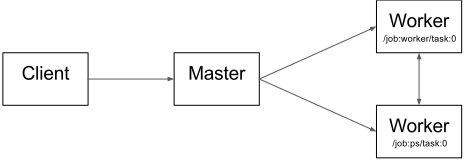
Figure illustrates the interaction of these components.
"/job:worker/task:0" and "/job:ps/task:0" are both tasks with worker services.
Example:
```python
workers, _ = tf.test.create_local_cluster(num_workers=2, num_ps=2)
worker_sessions = [tf.compat.v1.Session(w.target) for w in workers]
with tf.device("/job:ps/task:0"):
...
with tf.device("/job:ps/task:1"):
...
with tf.device("/job:worker/task:0"):
...
with tf.device("/job:worker/task:1"):
...
worker_sessions[0].run(...)
```
Args:
num_workers: Number of worker servers to start.
num_ps: Number of PS servers to start.
protocol: Communication protocol. Allowed values are documented in the
documentation of `tf.distribute.Server`.
worker_config: (optional) `tf.ConfigProto` to initialize workers. Can be
used to instantiate multiple devices etc.
ps_config: (optional) `tf.ConfigProto` to initialize PS servers.
Returns:
A tuple `(worker_servers, ps_servers)`. `worker_servers` is a list
of `num_workers` objects of type `tf.distribute.Server` (all running
locally);
and `ps_servers` is a list of `num_ps` objects of similar type.
Raises:
ImportError: if portpicker module was not found at load time
"""
if _portpicker_import_error:
raise _portpicker_import_error # pylint: disable=raising-bad-type
worker_ports = [portpicker.pick_unused_port() for _ in range(num_workers)]
ps_ports = [portpicker.pick_unused_port() for _ in range(num_ps)]
cluster_dict = {
"worker": ["localhost:%s" % port for port in worker_ports],
"ps": ["localhost:%s" % port for port in ps_ports]
}
cs = server_lib.ClusterSpec(cluster_dict)
workers = [
server_lib.Server(
cs,
job_name="worker",
protocol=protocol,
task_index=ix,
config=worker_config,
start=True) for ix in range(num_workers)
]
ps_servers = [
server_lib.Server(
cs,
job_name="ps",
protocol=protocol,
task_index=ix,
config=ps_config,
start=True) for ix in range(num_ps)
]
return workers, ps_servers
def get_node_def_from_graph(node_name, graph_def):
"""Returns the `NodeDef` instance for given node name in the graph def.
This method explores only the NodeDefs in `graph_def.node`.
Args:
node_name: Name of the NodeDef to search for.
graph_def: An instance of `GraphDef` proto.
Returns:
the `NodeDef` instance whose name field matches the given node_name or None.
"""
for node_def in graph_def.node:
if node_def.name == node_name:
return node_def
return None
def set_producer_version(graph, producer_version):
"""Sets graph.graph_def_versions.producer to `producer_version`."""
# The C API doesn't expose altering GraphDefVersions. We can indirectly set
# it via import_graph_def though.
graph_def = graph_pb2.GraphDef()
graph_def.versions.producer = producer_version
with graph.as_default():
importer.import_graph_def(graph_def)
assert graph.graph_def_versions.producer, producer_version